

24/7 Access Makes the Difference: After-Hours Access to Emergency Departments Is Critical for Supporting Patients and Communities
Hospitals are the backbone of the healthcare system. Only hospitals and hospital emergency departments (EDs) provide comprehensive care around-the-clock to clinically complex patients and during emergencies, especially after normal business hours and overnight when other providers are closed. As a result, hospital EDs are a critical, indispensable and sometimes only access point to healthcare for patients and communities nationwide.
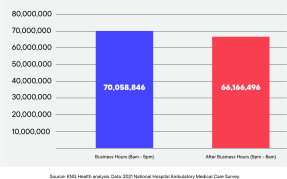
Nearly half of ED visits each year in the United States occur after normal business hours 1. – when patients often have nowhere else to turn to receive care.
Hospital EDs are there for around-the-clock pediatric emergencies, and for the parents who know their children can’t wait until the next available appointment to receive care.
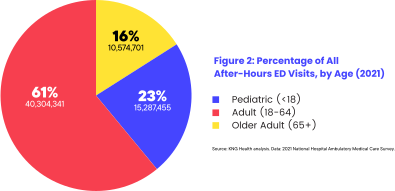
Hospital EDs, which treat everyone regardless of their ability to pay, are relied upon by pediatric patients. Children (under the age of 18) constituted 21% of all ED visits; 55% or 15.3 million of children’s ED visits occurred after standard business hours (Figure 2).
Rural patients rely on hospital EDs to receive care.
When each minute counts, after-hours care is critical for injuries, trauma, drug overdoses and poisonings.
Conclusion
Nearly half of all ED visits (49%) – or over 66 million – occur after normal business hours when physician offices and other providers are typically closed to in-person visits. The findings highlight hospitals’ and health systems’ critical role in providing lifesaving care when patients have nowhere else to turn, especially for rural and pediatric patients in life-threatening situations. Access to around-the-clock care provides immeasurable benefits to communities, who can trust their local hospital to be there for them when they need it most.
Sources
1) KNG Health Consulting Analysis, 2024
2) Ibid
3) Ibid
4) Ibid